The More You Limit, The More You Have: A Case for Intentional Scarcity

Photo: Dietmar Rabich, CC BY-SA 4.0, via Wikimedia Commons
Here's something that sounds completely backward: the people who report feeling the most satisfied with their wardrobes tend to own the fewest pieces. The folks who say they love their homes often have the least stuff in them. And the individuals who describe their mornings as calm and energized? They've usually already made most of their daily decisions the night before—or eliminated them entirely.
We've been sold the idea that more options equal more freedom. But neuroscience, behavioral psychology, and a growing number of people who've quietly opted out of the abundance game are telling a very different story.
Your Brain Is Exhausted Before Noon
In 2000, psychologists Sheena Iyengar and Mark Lepper ran a now-famous study at a California grocery store. They set up two jam-tasting stations—one with 24 varieties, one with just 6. The large display attracted more visitors. But the small one sold ten times more jam.
More options created more paralysis. Fewer options created more action—and more satisfaction.
This effect, which psychologist Barry Schwartz later named "the paradox of choice," shows up everywhere in modern American life. We spend 20 minutes scrolling Netflix before giving up and rewatching something we've already seen. We stand in front of a full closet and feel like we have nothing to wear. We browse 47 throw pillows on Wayfair and end up buying none of them, or the wrong one.
Every decision—no matter how small—draws from the same finite pool of mental energy. Researchers call this decision fatigue. And by the time you've chosen your breakfast, your outfit, your coffee order, and your podcast, you've already spent real cognitive resources that could have gone toward something that actually matters to you.
The fix isn't better decision-making. It's fewer decisions to make.
The Closet That Doesn't Fight Back
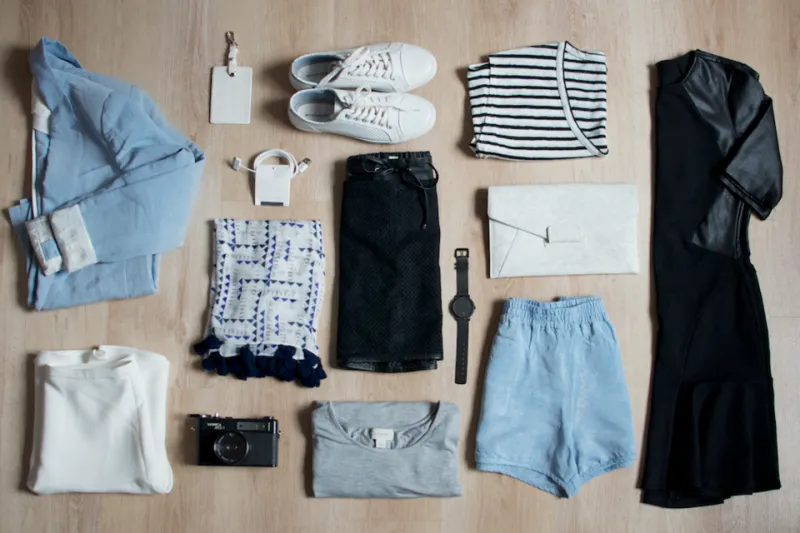
Most people who've experimented with a capsule wardrobe describe the same initial reaction: mild anxiety followed by surprising relief. When you pare down to 30 or 40 carefully chosen pieces that all work together, getting dressed stops being a negotiation with yourself.
You're not choosing between 12 variations of a similar shirt. You're just getting dressed.
What's interesting is that this doesn't feel like settling. It feels like clarity. When every item in your wardrobe has earned its place—when you genuinely like everything hanging there—the act of choosing becomes almost pleasurable rather than draining. There's no guilt about the things you never wear. No mental note to "eventually get to" that dress you bought on sale two years ago.
Japanese design philosophy has understood this for a long time. The concept of ma—the meaningful use of negative space—applies just as much to a wardrobe as it does to a room. The gap between things is where ease lives.
Constraint as Creative Fuel
Here's the part that surprises most people: limiting your options doesn't just reduce stress. It actually tends to make you more creative.
When designers, writers, and musicians are given total freedom, they often produce less interesting work than when they're given tight constraints. A filmmaker told to make any movie they want might stall for years. Tell them they have $10,000, a single location, and two actors, and they'll make something by Friday.
Constraint forces ingenuity. It makes you work with what you have instead of perpetually hunting for something better.
The same principle applies to your home. When you stop treating your living room as a blank canvas for unlimited accumulation and start working within deliberate limits—a specific palette, a set number of objects on a shelf, a rule about what can actually come through the front door—something shifts. You start seeing what you already own differently. You arrange things more thoughtfully. You notice details you'd stopped registering.
Scarcity, in this sense, sharpens attention.
What "Enough" Actually Feels Like
A lot of us have never really sat with the feeling of enough. We're conditioned to interpret satisfaction as a stopping point before the next want kicks in. Contentment gets confused with stagnation.
But people who've deliberately narrowed their choices—whether in their homes, their diets, their social calendars, or their possessions—often describe something that sounds almost radical: they stopped wanting things they didn't have.
Not because they suppressed the desire. But because the mental bandwidth that used to go toward evaluating options got redirected. Toward the meal they were actually eating. The room they were actually sitting in. The conversation they were actually having.
This is what intentional scarcity gives you. Not less. More presence.
How to Start Without Overhauling Everything
You don't have to sell your furniture and move into a 400-square-foot apartment to experiment with this. The entry point is much smaller.
Pick one area of your life where decision fatigue is quietly draining you. Maybe it's your morning routine. Maybe it's the kitchen cabinet with 14 different spice blends you've used twice. Maybe it's your streaming subscriptions.
Then reduce the options deliberately. Not randomly, not because you're punishing yourself—but because you're making room for the things that remain to actually mean something.
Choose fewer things. Choose them more carefully. Then stop choosing for a while.
What you'll likely find is that the things you kept start to feel better. Not because they changed, but because you finally gave them your full attention.
That's not scarcity. That's abundance with better aim.